



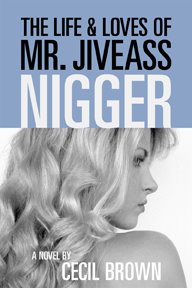
 A novel by Cecil Brown is quite a showstopper where ever I happened to be reading it. This version is a re-print of the original 1969 classic pulp fiction book and is updated to include a new forward by Henry Louis Gates, Jr. The new introduction lends some added credibility for those not deeply entrenched in identity politics or collegecurriculumreading to know the other works of the author. And I have to admit, Gates’ addition to this edition was a sociallifesaver for me when I read the text in public (especially in the community where I live). Ironically, my own identity is a blurry façade that continues to need unraveling, so there is a timeliness in reading this book for the larger, political and smaller, personal perspectives. In order to peel away the layers of intrigue within the text I think it an interesting exercise to begin with the cover art of each printing. Though you can’t always judge a book by its cover, I think you can begin to discern some of the meaning an author or publisher is trying to convey; as the case is with Mr. Jiveass Nigger, my interest is piqued.
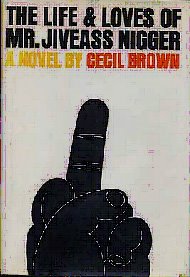 is the cover on the 1st edition (I don’t think this cover leaves much to the imagination.) ; and then,
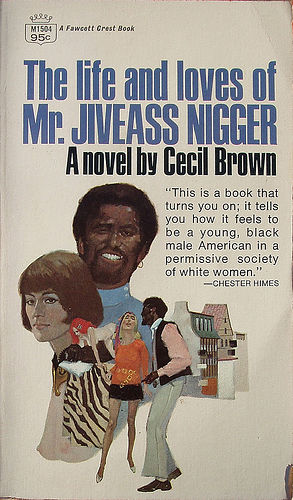 this edition was published in 1973. Each one markets a different audience and with it, interpretations that are sprung from the variant layers of meaning. I tried to read the middle edition shortly after I had graduated from high school at the behest of a friend. I was stunningly insulted by the flamboyant and unadulterated sexuality – particularly directed between black men and white women. I could not get past my own identity to read into the text so sloughed it off as pulp fiction. At that time I was a ‘surface’ reader and what jumped out at me most is that it seemed to me too racy and racially sexually charged.
I had forgotten all about the novel as my youth faded away and still was not re-introduced to the text even into my late-blooming collegiate career. The latter is not too surprising, given that I attended university in a largely ‘white’ community where ‘-isms’ are easily marginalized and ‘colored’ students came to play bad football or final four basketball. Yet, I mastered in a program fraught with -isms that sought to expose the underbelly of oppression from intensely theoretical angles, so it is disappointing that my program which claimed an interest in recruiting ‘students of color’ did not seek out such texts to analyze for the rich perspectives on gender, race, class, color, nationality and -isms of all flavors. But still, I am grateful because from such an academic space, I am fortunate that said education has afforded me the practiced patience of a studious learner in accessing those layers that I am still groping with three days after I’ve completed reading Brown’s work and laid the popfiction text aside.
And I am pleased to have read it now – under these circumstances (y’know with all that agedness and now certified smartiness), I still managed to learned a lot about myself in the telling of George Washington’s (Mr. Jiveass Nigger, himself) tale. It made me curious, more now than before I read the book, about why it was released at this moment. Because yet another layer in the work is the racial identifying that Brown expresses through the eyes of his protagonist. In our current and seemingly remarkable era, when our first African-American president is nearing his swearing in, the timing of a long-ago text broaching identity politics seems ill-conceived. Of course, it is not badly-timed at all, because it is the mixmash of identity and race and class and politics that are all fleshed out in Brown’s narrative. Matching the narrative themes with current political debate swirling in the media, in periodical prints, and floating about my head along with the heady text of Cecil Brown’s imagination seems so damn clever that I can scarce call it accidental that Brown was approached for it’s re-release at this juncture in our collective history. So there you have it – I suppose I have come to my own answers and conclusions on the timing of the book’s resurgence into popular, political and social interest.
And that brings me back to those darn layers! The cover art chosen for this edition is certainly telling. The letter-size and clearly legible fonting, coupled with the blaring image of the “white” woman had the most interesting effect in my community. Because I am a regular reader, I thought nothing of taking the text along with me wherever I went, to read in the snippets of the godot time that I invariably endure as part of my routine. While waiting for my younger son to be dismissed from kindergarten, my older son to be dismissed from high school, while out and about, I generally carry a book. This text was no different, but the response from people I do not know was remarkable as opposed the bored or’looking I usually receive. People were openly hostile to the word “nigger” that was largely visible from several feet away. And that I have embodied the ‘white’ woman figure on the cover made my carrying the text seem all that much more alarming in my circle. And I cannot deny that the text continues to feel racially violent in a sexualized context. So to muddy the waters and add to the irony, I have recently discovered my own African-American roots, not too far removed. How it came to be that I should be the whitest black girl that anyone could imagine is a whole other story in itself (and maybe a good novel one day in its own right). Yet, I am also reeling from my own sense of identity.
So the country, neh– the world, is also uncovering dusty old identity politics to learn more about themselves. And here is Cecil Brown… re-releasing his charged tome on the subject(s) for us to analyze again, under our newfound circumstances. Gates is correct in pointing out the importance of this work – not just from his own perspective and history – but also for the African Americans left in the trenches of american life and who are still jiving – and for the rest of us, the “white” folks who need to learn more about ourselves and our identity in the larger world. Read, be patient with yourself and read it all — the whole tale of the Life and Loves of Mr. Jiveass Nigger himself!

 the Bitch in the house